
Have you recently been told you have an ovarian cyst after an ultrasound? Or maybe you’re dealing with pelvic pain, bloating, or irregular periods and wondering if a cyst could be the reason?
Take a deep breath—you are not alone. Ovarian cysts are incredibly common, and the good news is that most ovarian cysts are harmless, painless, and disappear on their own without treatment. The internet is full of scary stories, but the reality is much more reassuring.
At Om Global Hospital, Faridabad, we believe that understanding your health shouldn’t feel confusing or frightening. Let’s break everything down in simple language so you know when an ovarian cyst is perfectly normal and when it’s time to see a doctor.
What Is an Ovarian Cyst?
An ovarian cyst is a fluid-filled sac that develops on or inside an ovary. Think of it like a tiny water balloon that forms during your menstrual cycle.
Most women will develop at least one ovarian cyst during their reproductive years—and many never even realize it because they cause no symptoms.
Quick Answer
What is an ovarian cyst?
- A fluid-filled sac on or inside an ovary.
- Most are non-cancerous (benign).
- Many disappear naturally within 1–3 menstrual cycles.
- Often discovered during a routine ultrasound.
Why Do Ovarian Cysts Form?
Your ovaries work hard every month.
During each menstrual cycle, a tiny sac called a follicle grows and releases an egg. Sometimes that follicle doesn’t open or doesn’t shrink afterward. Instead, it fills with fluid and becomes what’s called a functional ovarian cyst.
That’s why these cysts are considered a normal part of ovarian function rather than a disease.
Common reasons ovarian cysts develop include:
- Normal ovulation
- Hormonal changes
- Pregnancy
- Endometriosis
- Polycystic Ovary Syndrome (PCOS)
- Previous ovarian cysts
- Certain fertility medications
Types of Ovarian Cysts Explained Simply
Understanding the different types makes the condition much less intimidating.
Functional Cysts
These are the most common.
They usually:
- Develop during ovulation
- Are harmless
- Cause little or no discomfort
- Disappear naturally
Corpus Luteum Cysts
After releasing an egg, the follicle becomes the corpus luteum. Sometimes it fills with fluid instead of shrinking.
Most resolve on their own.
Dermoid Cysts
These are unusual but usually benign.
Because they develop from cells capable of forming different tissues, they may contain hair, skin, or fatty tissue.
Endometriomas
These occur in women with endometriosis, where tissue similar to the uterine lining grows outside the uterus.
Cystadenomas
These develop from ovarian tissue and may contain watery or mucus-like fluid.
Although they can grow quite large, many remain non-cancerous.
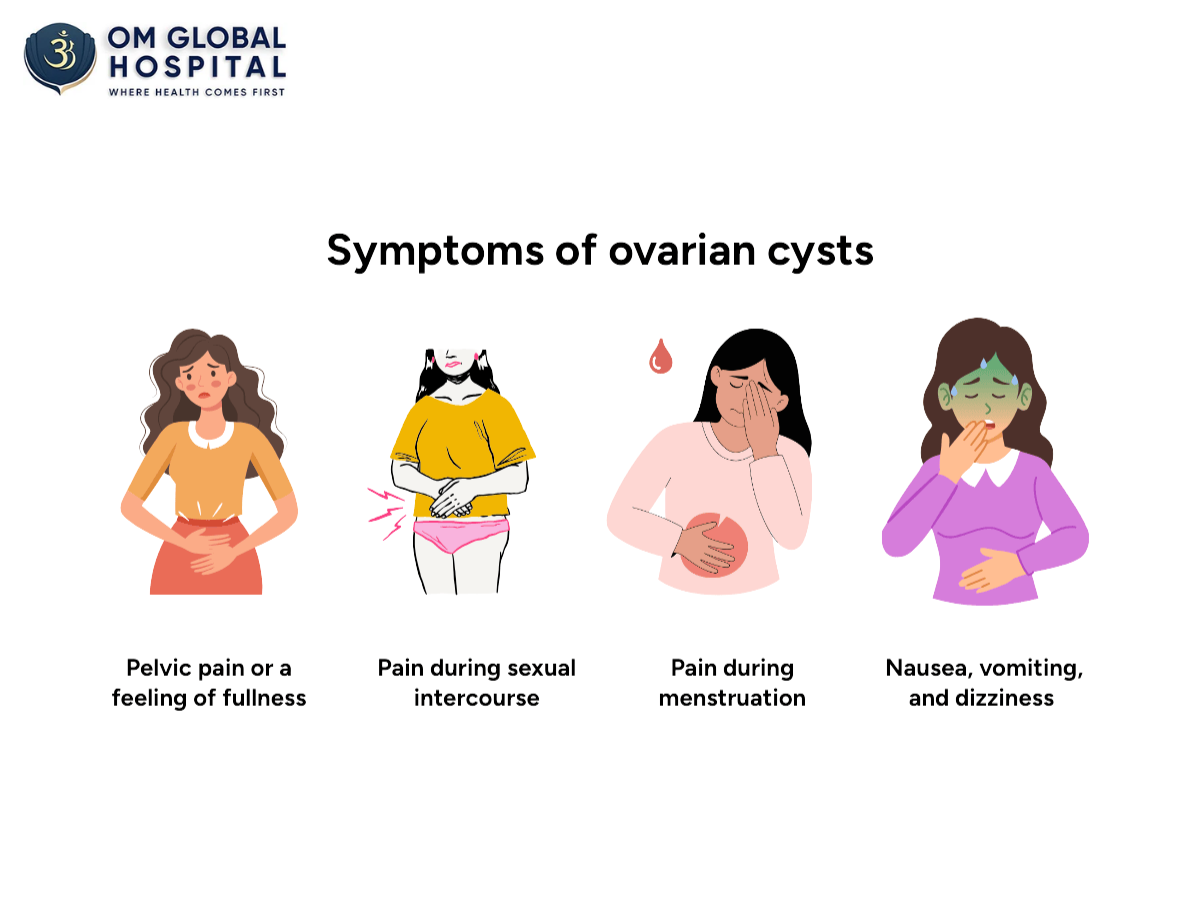
What Symptoms Can an Ovarian Cyst Cause?
Many women have no symptoms at all.
Others may notice:
- Pelvic pain
- Lower abdominal discomfort
- Bloating
- Feeling full quickly
- Pain during intercourse
- Irregular periods
- Frequent urination if a large cyst presses on the bladder
- Mild lower back pain
Sometimes the discomfort comes and goes, making it difficult to identify the cause.
When Is an Ovarian Cyst an Emergency?
While most cysts are harmless, some situations require immediate medical attention.
Seek emergency care if you experience:
- Sudden severe pelvic pain
- Pain with fever
- Pain with vomiting
- Heavy vaginal bleeding
- Fainting or dizziness
- Difficulty walking because of pain
These symptoms may indicate:
- Ovarian torsion (twisting of the ovary)
- A ruptured cyst
- Internal bleeding
Prompt treatment can help protect the ovary and prevent complications.
How Do Doctors Diagnose Ovarian Cysts?
Fortunately, diagnosing an ovarian cyst is usually straightforward.
Your doctor may recommend:
Medical History
You’ll be asked about your symptoms, menstrual cycle, and previous health conditions.
Pelvic Examination
This helps identify tenderness or enlargement.
Ultrasound Scan
Ultrasound is the best way to evaluate ovarian cysts.
It helps determine:
- Size
- Shape
- Location
- Whether the cyst contains fluid or solid material
Additional Tests (When Needed)
Depending on your age and ultrasound findings, your doctor may suggest:
- Blood tests
- Pregnancy test
- Tumor marker tests (such as CA-125 in selected cases)
- MRI or CT scan in complex situations
Do All Ovarian Cysts Need Treatment?
No. Most ovarian cysts do not need treatment.
Many women only need regular monitoring.
Treatment depends on:
- Your age
- Symptoms
- Cyst size
- Ultrasound appearance
- Whether you’re before or after menopause
Observation
Small functional cysts often disappear naturally.
Your doctor may simply repeat an ultrasound after several weeks.
Medications
Pain relievers may help ease discomfort.
Hormonal birth control pills may reduce the chance of developing new functional cysts, although they don’t make existing cysts disappear faster.
Surgery
Surgery may be recommended if the cyst:
- Is very large
- Persists over time
- Causes severe pain
- Twists the ovary
- Ruptures with complications
- Appears suspicious on imaging
Modern laparoscopic (keyhole) surgery often allows quicker recovery with smaller incisions.
Can Ovarian Cysts Affect Fertility?
Usually, no. Most ovarian cysts do not affect fertility.
Functional cysts are part of normal ovulation.
However, fertility may be affected if cysts are related to:
- Endometriosis
- PCOS
- Extensive ovarian surgery
- Rare ovarian disorders
The reassuring news is that many women with ovarian cysts conceive naturally and have healthy pregnancies.
How Can You Support Ovarian Health?
While ovarian cysts can’t always be prevented, healthy habits can support overall reproductive health.
Simple everyday tips:
- Maintain a healthy weight.
- Stay physically active.
- Eat plenty of fruits, vegetables, and whole grains.
- Drink enough water.
- Keep track of your menstrual cycle.
- Don’t ignore persistent pelvic pain.
- Attend regular gynecological check-ups.
Think of routine check-ups like servicing your car—you may catch small issues before they become bigger problems.
Meet the Expert
Dr. Deepa Aggarwal ,Dr. Praveen Chopra
Consultant – Obstetrics & Gynaecology
At Om Global Hospital, Doctor is dedicated to helping women feel informed, comfortable, and confident about their reproductive health. With years of experience in diagnosing and treating ovarian cysts, menstrual disorders, pregnancy care, and other gynecological conditions, Doctor believes that every patient deserves clear explanations, evidence-based treatment, and compassionate care.
Whether your ovarian cyst simply needs monitoring or requires advanced treatment, the focus is always on choosing the safest and least invasive approach for your individual needs.
Patient Voices
⭐⭐⭐⭐⭐
“I was terrified after my ultrasound showed an ovarian cyst. Dr. Praveen Chopra explained everything patiently and reassured me that it was a functional cyst. Three months later, it had completely disappeared. I couldn’t have asked for better care.”
— Neha S., Faridabad
⭐⭐⭐⭐⭐
“The doctors never rushed me. Every question I had was answered in simple language, and the treatment plan was explained clearly. I felt supported throughout the process.”
— Priya M.
⭐⭐⭐⭐⭐
“From the reception staff to the gynecology team, everyone was caring and professional. My laparoscopic surgery went smoothly, and my recovery was much faster than I expected.”
— Ritika G.
Your Treatment Journey at Om Global Hospital
| Step | What Happens |
| Step 1 | Consultation with a gynecologist |
| Step 2 | Medical history and pelvic examination |
| Step 3 | Ultrasound evaluation |
| Step 4 | Diagnosis and personalized treatment plan |
| Step 5 | Observation, medication, or surgery (if needed) |
| Step 6 | Follow-up visits and repeat ultrasound when required |
Frequently Asked Questions
Can an ovarian cyst disappear on its own?
Yes, many ovarian cysts disappear naturally within a few months. Functional cysts commonly resolve without medication or surgery, which is why doctors often recommend follow-up ultrasounds before considering treatment.
Is an ovarian cyst always painful?
No, many ovarian cysts cause no pain at all. Some women only discover they have one during a routine ultrasound or health check-up.
Can ovarian cysts turn into cancer?
Most ovarian cysts are not cancerous. Your doctor evaluates the cyst’s size, appearance, and your age to determine whether additional testing is needed.
What foods should I avoid if I have an ovarian cyst?
There isn’t one specific food that causes ovarian cysts. Eating a balanced diet rich in vegetables, fruits, lean protein, and whole grains supports overall hormonal and reproductive health.
When should I see a doctor for pelvic pain?
You should see a doctor if pelvic pain is persistent, severe, or keeps coming back. Sudden intense pain, fever, vomiting, or fainting requires immediate emergency medical care.
Can I get pregnant if I have an ovarian cyst?
Yes, most women with ovarian cysts can become pregnant normally. Fertility usually depends on the underlying cause of the cyst rather than the cyst itself.
Take the Next Step Toward Peace of Mind
If you’ve been diagnosed with an ovarian cyst—or you’re experiencing pelvic pain, bloating, or irregular periods—don’t let uncertainty keep you worried. A timely evaluation can provide answers, reassurance, and the right treatment if needed.
📞 Call Us Today
Phone: 096679 31822
📅 Book Your Consultation
Visit Om Global Hospital
Om Global Hospital
Plot No. 400, Opposite HUDA Market,
Sector 7, Faridabad, Haryana 121006